Clara Radley kills Stuart Harper
The RadleysClara Radley’s killing of Stuart Harper is the act that turns a private, abnormal encounter into a crisis for the Radley family. Its aftermath links three kinds of consequence: Clara’s altered response to police questioning, her later distress at the family’s conflict, and the public confirmation of Harper’s death when his body is found.
Circumstances and Retrospective Explanation
The available account does not narrate the killing itself in detail. It presents the event through what follows: Clara is interviewed about a boy she is responsible for killing, and later she and Rowan Radley discuss what happened. Clara thinks back to a recent experience in Topshop, while Rowan distinguishes the Harper encounter from a normal situation. His explanation is that Clara had gone from having no blood to having a great deal, and that the effects are now wearing off. This places the killing in the context of a sudden and extreme change, without making the encounter ordinary or removing the fact that Harper died.
Rowan’s account is also a defense of Clara. He argues that a girl with fangs would have acted as she did, presenting the event as an outcome of circumstances and capability rather than a choice Clara should continue to regret. Clara does not simply accept that reassurance: she says she has behaved badly over the weekend. The exchange therefore leaves two understandings side by side. Rowan stresses how exceptional the situation was; Clara remains troubled by what she did and by what has followed.
Police Interview and Knowledge of the Killing
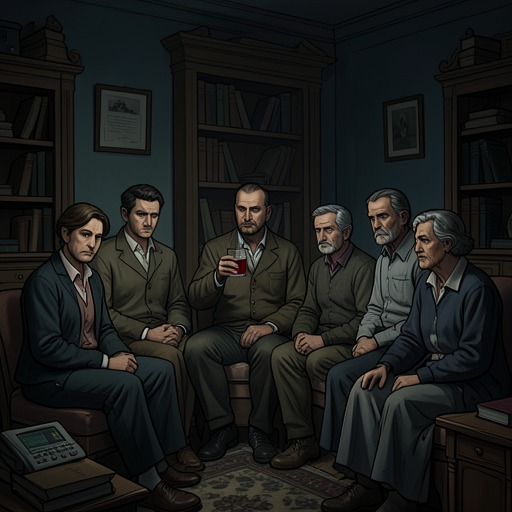
The first extended aftermath shown is a police interview in the Radleys’ living room. Clara sits on the sofa between her parents while two officers question her about Harper. A next-door neighbor appears to have done everything possible to incriminate her, giving the interview the outward shape of a serious accusation. Yet Clara experiences it as strangely unreal and, at moments, almost fun. She knows she ought to be worried and tries to share her mother’s anxiety, but cannot summon it to the degree she expects.
That contrast gives the interview its significance. The circumstances would normally be frightening: Clara is questioned about a death for which she is responsible, with her parents beside her and a neighbor apparently strengthening the case against her. Instead, the scene registers a disconnection between what Clara understands she should feel and what she can actually feel. The officers’ polite manner contributes to the interview’s ordinary surface; one asks why Stuart came after her, smiling along with the other officer. The scene does not establish that Clara has confessed or explain the neighbor’s evidence. It shows that the killing has brought her under police scrutiny, while her response remains unexpectedly detached.
Guilt and Conflict at Home
The consequences do not end with the interview. In a later conversation, Clara hears her parents arguing and wonders whether the conflict is her fault. She connects their distress directly to Harper’s death: if she had not killed him, she thinks, they would not be fighting. Rowan tells her that the argument is not about her and suggests that the disagreement had been building already. His answer does not fully comfort her. Clara’s reasoning shows how the killing has become more than an isolated act in her mind: she now reads the strain inside the family as part of its aftermath.
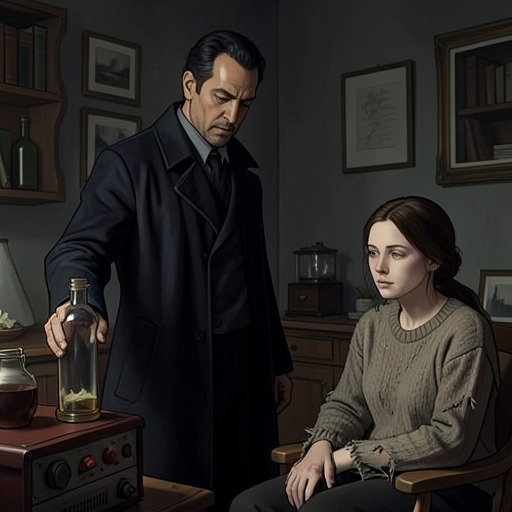
The conversation also leads Rowan to take a bottle from beneath his bed. Clara looks at the half-drunk liquid with astonishment. The passage makes the bottle a concrete presence in this exchange, but does not identify its contents there. Its appearance follows Rowan’s unsuccessful attempt to reassure her, marking a shift from conversation toward an unspoken response. Clara’s later admission that she has been a complete tool over the weekend confirms that her concern persists even when Rowan tries to explain the circumstances.
Discovery and Narrative Significance
The discovery of Harper’s body changes what Helen Radley knows. Earlier, she had watched the news and found no report of the discovery, which allowed her to hope that a book-group acquaintance had been mistaken. Alison Glenny then tells Helen that Harper’s body has been found and that the authorities know Clara killed him. Helen cannot answer coherently at first. The news converts a fear she had been holding at a distance into an explicit accusation against her daughter.
These aftermath scenes distribute the event’s meaning rather than resolving it with a single account. For the police, the killing is the subject of an interview and an investigation; for Helen, the body’s discovery makes the danger undeniable; for Clara, it becomes a source of guilt that seems to reach into her parents’ relationship. Rowan supplies a counter-reading rooted in the extraordinary circumstances he associates with her experience of blood. The tension between that explanation and Clara’s continuing distress keeps the killing from being treated either as an uncomplicated act of culpability or as something without consequences. Harper’s death remains the fixed fact around which the family’s fear, defense, and self-reproach gather.